St. Petersburg is a city built on water, stone, and imperial ambition. While its palaces and canals draw the eye, its cathedrals capture the soul. Unlike the clustered onion domes of Moscow, St. Petersburg’s great churches are sprawling, neoclassical, and deeply tied to the Romanov dynasty and the tragedies of Russian history. They serve as military memorials, museums of stone, and canvases of mosaic. For the traveler seeking to understand the city’s character, four cathedrals stand above the rest, each offering a distinct chapter in the story of the Northern Capital.
St. Isaac’s Cathedral: The Imperial Colossus
No building better captures the sheer, overwhelming scale of the Russian Empire than St. Isaac’s Cathedral. Commissioned by Tsar Nicholas I and designed by the French-born architect Auguste de Montferrand, this structure took four decades to complete, finally consecrating in 1858 . It was intended to be the principal cathedral of the capital, and everything about it is designed to intimidate and awe.
The Architecture and Interior
St. Isaac’s is a masterpiece of late neoclassicism, but its grandeur lies in its materials. The massive central dome is plated with pure gold, a beacon visible from across the city . The exterior is ringed by 112 monolithic granite columns, each weighing over a hundred tons, hauled from the Finnish coast . Inside, the opulence is almost overwhelming. The iconostasis is framed by columns of vivid green malachite and deep blue lapis lazuli . What appears to be a vast collection of oil paintings is actually a series of intricate mosaics, utilizing thousands of tiny glass pieces to create images that rival the brushwork of the old masters .
The Colonnade and the View
While the interior is a museum of precious stones, the true highlight for many visitors lies outside, atop the building. A separate ticket allows access to the colonnade that encircles the drum of the central dome . After climbing 262 steps, you are rewarded with the definitive 360-degree panorama of St. Petersburg . To the west lies the Neva River and the bronze horseman; to the east, the Nevsky Prospect stretches out like a ribbon. During the summer “White Nights,” the colonnade stays open late, offering views of the city bathed in the famous twilight .
Practical Notes
Located at St. Isaac’s Square, 4, the cathedral is easily reached from Admiralteyskaya Metro Station. Entrance to the cathedral and the colonnade require separate tickets, so purchase accordingly . It is worth noting that during World War II, the golden dome was painted gray by city residents to avoid attracting enemy bombers, a testament to its status as a primary landmark .

Ready to book your guided tours in St Petersburg?
The Church of the Savior on Spilled Blood: The Mosaic Reliquary
If St. Isaac’s represents the cold, calculated grandeur of the state, the Church of the Savior on Spilled Blood represents the raw, emotional heart of Russian Orthodoxy. Built on the exact spot where Emperor Alexander II was mortally wounded by a bomb in 1881, this cathedral is a deliberate departure from the neoclassical fashion of the city .
The Architecture and History
Alexander III ordered the construction of this church as a memorial to his father. The architect, Alfred Parland, drew inspiration from the medieval churches of Yaroslavl and Moscow, resulting in the colorful, onion-domed silhouette that tourists often mistake for St. Basil’s . The central dome stands 81 meters high, a deliberate numerical reference to the year of the Tsar’s death (1881) . The church was completed in 1907 but suffered severe damage during the Soviet era, serving as a morgue during the Siege of Leningrad and later a warehouse . It was only reopened as a museum in the 1970s after decades of restoration.
The Mosaic Collection
The interior is a singular artistic achievement. Unlike St. Isaac’s, which mixes painting and mosaic, the Savior on Spilled Blood is almost entirely covered in mosaics. Over 7,500 square meters of wall space are adorned with intricate biblical scenes and figures, created by the finest artists of the time, including Viktor Vasnetsov and Mikhail Nesterov . The sheer density of the colors and the gleam of the glass create an atmosphere that is both mournful and breathtaking. A special canopy is preserved inside over the exact section of cobblestone where Alexander II fell, ensuring the building never forgets its purpose as a site of mourning .
Practical Notes
The church is located on the Griboyedov Canal Embankment, a short walk from Nevsky Prospect. It is open daily except Wednesdays, with evening openings during the summer months . Because it is one of the most popular attractions in the city, it is highly recommended to arrive early in the morning or late in the afternoon to avoid the crush of tour groups . The exterior, with its swirling colors and canal-side reflection, is best photographed at sunset.
Kazan Cathedral: The Military Shrine
While the other cathedrals on this list are museums first, Kazan Cathedral remains a living, breathing place of worship and a powerful symbol of Russian military glory. Situated on the bustling Nevsky Prospect, its massive curved colonnade reaches out like open arms, mirroring the design of St. Peter’s Basilica in Rome .
The Colonnade and Architecture
Designed by Andrey Voronikhin and completed in 1811, the cathedral was built to house the revered Kazan Icon of the Mother of God . The most striking feature is the semicircular colonnade of 96 Corinthian columns that faces the street. This architectural decision allowed the cathedral to maintain its traditional east-facing altar while presenting a grand, theatrical facade to the main avenue . The interior is dim and solemn, with massive granite columns supporting the vaults and a sense of quiet reverence permeating the space, even with the constant stream of visitors .
The 1812 Connection
Kazan Cathedral is inextricably linked to the Patriotic War of 1812. After Napoleon’s defeat, the cathedral became a memorial to the Russian victory. Field Marshal Mikhail Kutuzov, the commander who led the Russian forces, was buried here in 1813 . His tomb is a place of pilgrimage for military historians. The cathedral also housed captured French standards and keys to European cities taken by the Russian army, some of which remain on display near the tomb . Bronze statues of Kutuzov and Barclay de Tolly stand outside on the square, forever guarding the church they helped make famous .
Practical Notes
Unlike St. Isaac’s and the Savior on Spilled Blood, Kazan Cathedral is free to enter . It is an active church, so visitors should dress modestly and maintain a respectful silence. The best time to visit is early morning, when the incense hangs heavy in the air and the crowds have not yet arrived . It is located at Kazanskaya Square, 2, right on Nevsky Prospect, making it an essential stop on any walking tour of the city.

Book a Cathedral tour in St Petersburg today
Smolny Cathedral: The Blue Pearl of the Neva
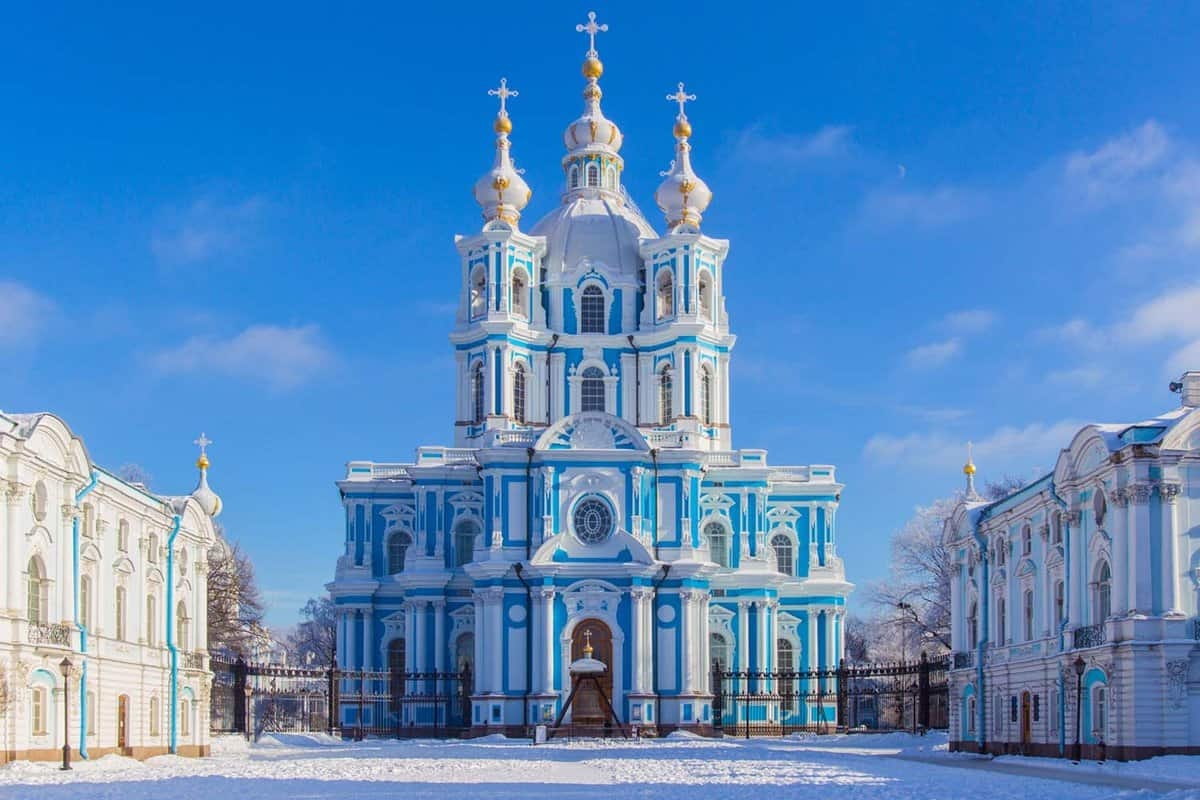
A short distance from the historic center, on the left bank of the Neva, stands the Smolny Cathedral, a masterpiece of Elizabethan Baroque that feels like a relic from a fairy tale. Designed by Bartolomeo Rastrelli, the same architect behind the Winter Palace, this cathedral was originally intended as the centerpiece of a convent for Elizabeth Petrovna, though she later abandoned the monastic life for the throne .
The Rastrelli Masterpiece
The defining feature of Smolny is its color: a brilliant, sky-blue facade adorned with white columns and elaborate, gilded cupolas . Rastrelli’s design is characterized by a sense of lightness and energy, with large windows and a soaring central dome that floods the interior with natural light. Construction began in 1748 but stalled after the Empress’s death. It took 87 years to complete, finally consecrating in 1835 with an interior designed by Vasily Stasov in a more restrained neoclassical style . This contrast between the exuberant baroque exterior and the austere interior is part of what makes Smolny unique.
The View from the Belfry
For those willing to climb, Smolny offers one of the most rewarding views in the city. The bell tower, standing 50 meters high, features an observation deck accessible via 278 steps . From this vantage point, you can see the winding Neva, the industrial district of Peski, and the surrounding convent buildings. It is a quieter, more local perspective than the one from St. Isaac’s, offering a glimpse of the city beyond the tourist center.
Practical Notes
Smolny Cathedral is located at Rastrelli Square, 1. While entrance to the cathedral itself is free, there is a small fee to climb the belfry . It is slightly off the beaten path compared to the other three, but easily reachable by metro (Chernyshevskaya or Ploshchad Vosstaniya). Because it remains an active church and is often less crowded than the central cathedrals, it offers a peaceful respite. Visitors should note that the convent buildings now house the St. Petersburg Municipal Government, which adds a layer of modern political significance to the historic site . Much of St Petersburg can be covered on a half day walking tour of St Petersburg.
A Final Word on Planning
These four cathedrals represent the four pillars of St. Petersburg’s identity: the imperial state (St. Isaac’s), the tragic soul (Savior on Spilled Blood), the military heart (Kazan), and the baroque dream (Smolny). For the traveler, they are best visited over two days, allowing time to climb the colonnades and belfries without rushing.
A few universal tips apply. First, purchase tickets in advance or arrive early, especially during the summer high season. Second, respect the dual nature of these sites: they are museums, but they are also active places of worship. Shoulders should be covered, and loud conversation should be avoided. Finally, consider visiting during the evening “White Nights” (late May to early July), when the cathedrals are illuminated against the never-ending twilight, a phenomenon that adds a layer of magic to already extraordinary buildings . Whether you are a historian, an architecture enthusiast, or simply a curious traveler, these four cathedrals will leave an indelible impression of a city that has always looked to the heavens while building its empire on earth.