Five Must-Do Experiences in St Petersburg: An Essential Guide from Imperial Palaces to Underground Palaces
St Petersburg is not a city that can be “done” in a hurry. Built on the delta of the Neva River, it is sliced by canals and bridges into countless fragments that reward slow drifting, and each fragment is packed with palaces, churches, theatres, and a kind of stubborn imperial aesthetic. If you have limited time and try to tick off every “must-see” item on the list, the result is usually exhaustion in a crowd and a memory of nothing in particular. What actually works is choosing five things and giving each of them a proper block of time. The five experiences below cover the city’s core faces: art, faith, power, everyday life, and a palace built underground.
One: Spend Half a Day in the Winter Palace, But Do Not Try to “See It All”
The Hermitage Museum, housed in the mint-green and gold Winter Palace facing the Neva, is the one thing in St Petersburg you cannot skip. It is one of the largest art museums in the world, with a collection of over three million items and exhibition space measured in tens of thousands of square metres. If you attempt to see everything, you will end up mechanically moving through corridors and forgetting even Leonardo’s name.
The right approach is to buy tickets online in advance, then lock onto a handful of things you genuinely want to see. The Italian Renaissance rooms hold two genuine Leonardo da Vinci paintings — the Benois Madonna and the Madonna Litta — and since only around a dozen surviving oil paintings by Leonardo exist in the world, two of them being here is no small thing. Rembrandt’s Return of the Prodigal Son is another work that stops people in their tracks; the light and the silence in that painting have a weight that keeps you standing there. Beyond the paintings, the palace interiors are half the point: the gilded marble of the Jordan Staircase, the scale of the throne room, and the ceiling frescoes and parquet floors that hurried visitors walk straight past. The building is imperial ambition made physical; the paintings are simply the guests living inside it.
A practical note: the Hermitage is open until 9 p.m. on Wednesdays and Fridays, and a late-afternoon entry in winter is often far quieter than a morning one. If you do not want to spend all your energy inside a museum, give yourself two or three hours, see the core rooms, and then walk out along the Neva to let your eyes recover from the visual density.

Two: Go Inside the Church of the Saviour on the Spilled Blood, Then Look Up
The Church of the Saviour on the Spilled Blood is probably the most photographed building in St Petersburg. The coloured onion domes, the mosaic-like facade decoration, and the reflection in the Griboyedov Canal make up one of the city’s definitive postcards. It stands on the exact spot where Alexander II was assassinated, which is where the “spilled blood” in the name comes from, and the contrast between the fairy-tale exterior and that grim history is itself a kind of metaphor for the city’s character.
Many people photograph it from outside and leave. That is a serious loss. Step inside and you discover that every square inch of surface — genuinely every inch — from floor to dome is covered in mosaic. Not frescoes, mosaics. Millions of tiny tiles form the icons, biblical scenes, and decorative patterns, glinting with an almost wet lustre in the dim light. You walk in, stop without meaning to, look up, and say nothing for a long while. The shock is not religious in origin; it comes from the sheer human willingness to spend that much effort on decoration.
If you have the energy, there is an upper viewing level inside the church with a view over the canal and surrounding streets. But even without it, standing on the ground floor for fifteen minutes is worth the ticket.
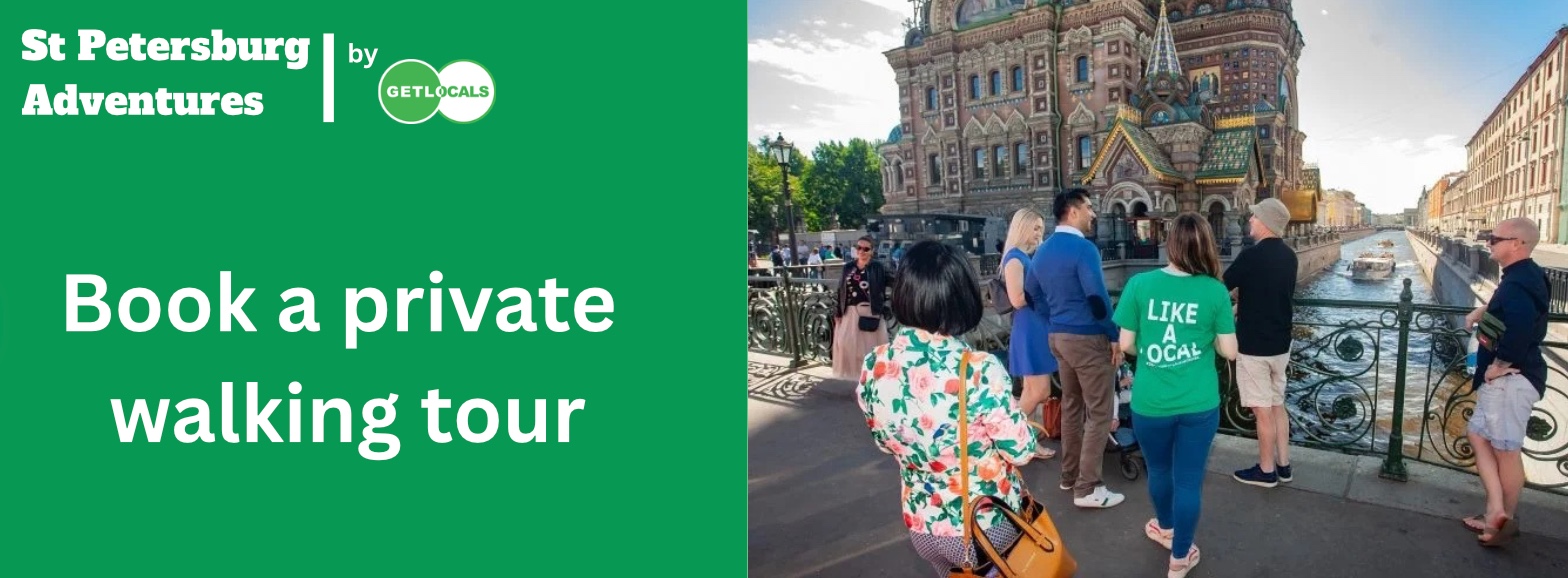
Guided walking tours in St Petersburg
Three: See a Ballet or an Opera at the Mariinsky
St Petersburg is one of ballet’s hometowns. The Mariinsky Theatre’s history runs almost parallel to the empire itself, and both Tchaikovsky’s Swan Lake and The Nutcracker premiered here. Even if you are not a devoted classical arts fan, watching a performance in a theatre with imperial boxes, crystal chandeliers, and deep red velvet is a way of understanding the city. Moscow’s Bolshoi is magnificent, but the Mariinsky’s standing in ballet is in no way inferior.
One ticketing detail worth knowing: besides the theatre’s official website, the city has many box offices called “Teatralnaya Kassa,” which charge a nominal “insurance” fee (usually around twenty roubles) and whose inventory sometimes does not fully overlap with the theatre’s own window. If there is a specific performance you badly want, checking both is worthwhile. If you are travelling with children, asking about a private box is a sensible move; ordinary seating can be cramped in ways that are unfriendly to kids.
If a full performance is too much, at least consider a shorter programme at the Mikhailovsky or the Alexandrinsky. Spending a St Petersburg evening only on dinner and a hotel room somewhat wastes what the city becomes after the lights come on.
Four: Ride the Metro, Specifically to Look at a Few Stations
This sounds like an odd recommendation, but the St Petersburg metro is itself a set of palaces buried a hundred metres underground. Because of the city’s geology, the stations are astonishingly deep, and the escalators are long enough to make you wonder whether you are descending toward the centre of the earth. Then the doors open and you are standing in a hall of marble and glass.
The one to go out of your way for is Avtovo. Half the columns are clad in white marble, the other half in pressed glass lit from within, and the whole platform reads like a hall built of crystal. It appears regularly on lists of the world’s most beautiful metro stations, and the praise is not exaggerated. Pushkinskaya is softer, with a statue of Pushkin at the end and the atmosphere of an old library. Kirovsky Zavod takes the solemn stone-temple route, while Narvskaya has relief panels of workers and soldiers running along the platform.
The method is simple: buy a single ticket, ride a few stops, get out, look, take photos, ride back. You do not need to use the metro as transport; treat it as an underground gallery route. The descending escalator is an experience in itself — that length and depth are rare in other cities.

Five: Go to Peterhof, But Do Not Stare Only at the Fountains
Peterhof is often called “the Russian Versailles.” Peter the Great’s summer palace sits on the southern shore of the Gulf of Finland, and the Grand Cascade with its gilded statues is genuinely spectacular. The Meteor hydrofoil from the Winter Palace pier is the most ceremonial way to get there, and approaching the palace from the water is worth the fare by itself. But if you see the fountains and turn back, you miss the part of this imperial estate that actually lets you relax.
What is genuinely worth doing is giving a full day to this direction. Take the electric train from Baltiysky Station to New Peterhof, walk first through Alexandria Park, look at the Gothic chapel, follow the quiet paths for a while, and only then enter the Lower Park to face the crowds at the Grand Cascade. The fountains have a launch ceremony at set times, and the moment the water pressure throws the jets into the sky does have a certain drama, but afterwards walk deeper into the park, along the shoreline of the Gulf of Finland, where the trees, the sound of water, and the gilt domes of the palace in the distance create a rhythm completely different from the city centre.
If time allows, save another stop for the suburbs on the way back. Peterhof is not the only imperial estate worth visiting: Tsarskoye Selo, with the Catherine Palace and its famous Amber Room, and the parks at Pavlovsk each have their own character, and the electric train from Vitebsky Station reaches Tsarskoye Selo in just over half an hour, with the park almost beside the station — an easy half-day that does not need to be rushed.
A Closing Note on Pace
The trap in St Petersburg is that it appears to have everything, and everything appears to be close together, so it is easy to fall into the greed of “just one more.” But the moments you actually remember from this city are often not on any list: a sudden sunset over the Neva, an accordion drifting out of a courtyard, or the discovery, halfway through a meal in a small Georgian restaurant, that it has started snowing outside.
The five things above cover art, faith, performance, everyday transport, and a palace outside the city, and each deserves at least half a day. Spread them out, leave gaps between them, and let the city come to you. St Petersburg does not need to be completed. It needs to be felt. Enjoy your St Petersburg tours.
Book a private guided tour in St Petersburg