Concrete Leningrad: A Traveler’s Guide to Brutalist St. Petersburg
St. Petersburg is a city that most visitors think they know before they arrive. They come expecting the pastel façades of the Winter Palace, the golden dome of St. Isaac’s, the canal-side charm of Dostoevsky’s novels. And they find all of that. But there is another city layered beneath and beyond the postcard image—a city of raw concrete, monolithic forms, and severe geometric poetry. This is the brutalist St. Petersburg, or more accurately, the brutalist Leningrad, a legacy of the late Soviet era that has quietly become a pilgrimage site for architects, photographers, and travelers seeking the “other” face of the northern capital.
What Brutalism Means in a Leningrad Context
Before mapping the buildings, it is worth untangling what brutalism actually means here. The term derives not from the English word “brutal” but from the French béton brut—raw concrete—a phrase coined by Le Corbusier to describe his preferred material . In the Soviet Union, the style took root later than in Western Europe, gaining real momentum in the 1970s and 1980s, when Soviet architects began embracing expressive, sculptural forms in reinforced concrete, brick, and glass . The publication of Rainer Banham’s The New Brutalism in Russian translation in 1973 helped catalyze the trend among Soviet professionals .
Leningrad’s brutalism, however, developed a distinct character. Unlike Moscow, where modernist interventions could be more aggressive, Leningrad’s historical center was fiercely protected. By the late 1960s, conservation zones had been established, and architects wishing to build anything conspicuous near the celebrated imperial ensembles faced steep approval hurdles . As a result, the city’s boldest brutalist experiments were pushed to the outskirts—to Vasilyevsky Island, to the northern residential districts, to the industrial fringes. This geographic dispersal is precisely what makes seeking out brutalism in St. Petersburg such a rewarding, if occasionally frustrating, pursuit. You cannot simply stroll from one masterpiece to the next. You need a plan, a map, and ideally, a local who knows where the concrete giants sleep.
The History: Why Concrete Took Root Here
The story of brutalism in St. Petersburg is inseparable from the broader narrative of Soviet postwar reconstruction and the Khrushchev-era pivot toward mass housing. After the devastation of World War II, Leningrad’s priority was not triumphant experimentation but healing and housing. The city had suffered enormously, and the postwar decade was spent on reconstruction rather than grand ideological statements in architecture .
By the 1960s, however, the pressure to build quickly and cheaply led to the dominance of panel housing—the infamous khrushchyovki and their successors. But within this utilitarian landscape, a generation of architects began to push against pure standardization. They looked to Finland for inspiration, to the legacy of Leningrad constructivism, and to the growing body of Western architectural theory becoming available in translation . Reinforced concrete, with its plasticity and structural potential, offered a way to create forms that were monumental without being decorative—an aesthetic that aligned with Soviet ideology’s rejection of “bourgeois excess” .
By the 1980s, brutalism had become the language of institutional ambition in Leningrad. Research institutes, hotels, cultural palaces, and transport hubs were designed as sculptural statements in concrete and brick. The style persisted even into the post-Soviet period, with some projects—like the Russian State Naval Archive—only completed in the 2000s, long after the ideology that birthed them had collapsed . Today, these buildings occupy an ambiguous place in the city’s self-image: too recent to be beloved heritage, too distinctive to be ignored.
Where to Find Brutalism in St. Petersburg
The Fifth Corpus of LETI: Red Brick Monumentality
Start with the most unusual specimen. The Fifth Corpus of the Leningrad Electrotechnical Institute (LETI), built in 1975 by Viktor Leviash and Naum Matusevich, is a rare example of brick brutalism. The building’s façade is a complex, almost sculptural composition of red brick and pale concrete, with a plasticity that architectural historians Anna Bronovitskaya and Nikolai Malinin have described as having no equivalent in the Soviet Union . The interplay of courtyard spaces and the sheer expressive force of the brickwork make this a essential stop for anyone serious about the style.
Location: Ulitsa Professora Popova, Petrograd Side.
The Russ Hotel: The “Stalactite” Anomaly
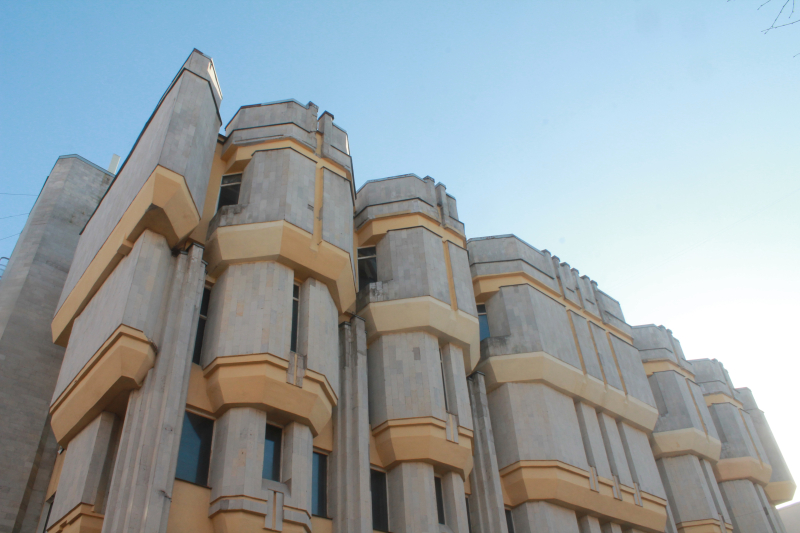
In the heart of the historical city, just off Nevsky Prospekt, stands one of the strangest buildings in St. Petersburg. The Russ Hotel (formerly part of the complex on Artilleryskaya Street) was reconstructed between 1983 and 1990 from an earlier constructivist residential building. The result is a structure that seems to defy gravity: each successive floor overhangs the one below, creating a “stalactite” effect that is at once aggressive and oddly beautiful. Thick walls, gunport windows, and a fortress-like presence mark it unmistakably as brutalist . Guides note that the building’s main façade has been discussed for reconstruction, so see it while its strange silhouette remains intact .
Location: Artilleryskaya Street, near Nevsky Prospekt.
The Avtobaza on Khersonskaya: Garage Brutalism at Its Finest
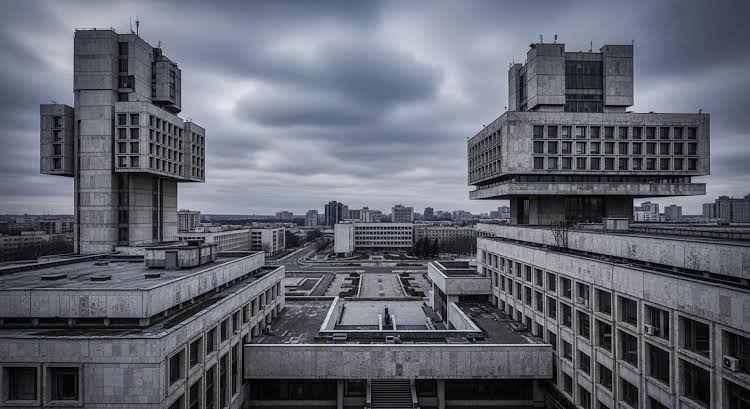
Built in 1985 by architect Vladimir Fryfald for the Smolny District Party Committee, this vehicle depot occupies an entire city block and is widely considered a masterpiece of Soviet modernism. Its three façades are each distinct: a broken, book-like contour at the front, a ship’s-bow curve at the rear, and two massive cylindrical ramps for vehicle access. One ramp, sunk into a deep niche, anchors the corner composition; the other, visible from Khersonsky Passage, is so monumental that critics have compared it to Frank Lloyd Wright’s Guggenheim Museum . This is brutalism in its most functional, uncompromising form—a building that makes no apology for what it is.
Location: Khersonskaya Street, near the historical center.
The Marine Station: Romantic Brutalism on the Water
Perhaps the most beloved of Leningrad’s brutalist buildings, the Marine Passenger Station (1982, architect Vitaly Sofronov) sits at the western edge of Vasilyevsky Island, a seven-story concrete vessel with aluminum panels that evoke sails filled with wind . Built for the 1980 Olympics, the building was designed to house passenger facilities on its lower floors and a sailors’ rest base above. Its silhouette—a tower with a radar dome, a cantilevered canopy, and that distinctive “sail” façade—has made it an icon of the city’s maritime gateway . Though currently unused, it remains one of the most photographed brutalist structures in the city.
Location: Ploshchad Morskoy Slavy, Vasilyevsky Island.
The “Houses on Chicken Legs”: Brutalist Housing at Its Most Audacious
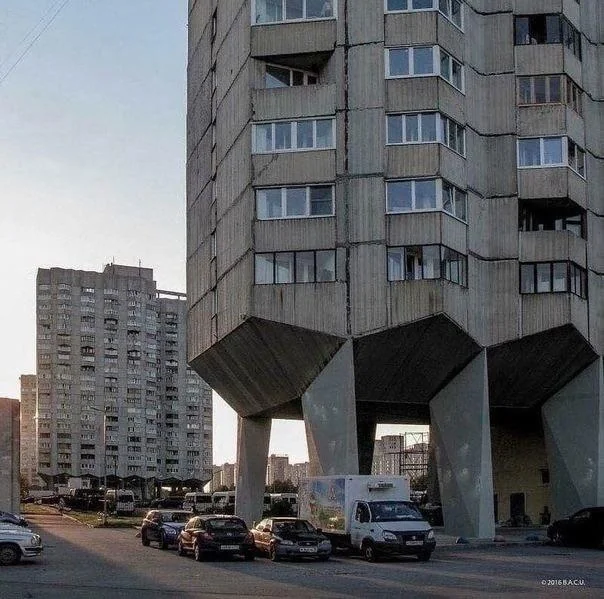
On the Smolenka River embankment, four monolithic tower blocks stand on massive conical supports, giving them the nickname “houses on chicken legs” (or “curi legs”). Built between 1987 and 1993, these were part of an ambitious waterfront development plan that was never completed; only four of the intended sequence were built . The buildings are structurally daring—the entire load of each tower is carried by a central core containing the single entrance—and visually unforgettable, especially at dusk. They represent brutalism’s brief, bold foray into residential architecture in Leningrad, and remain among the most photographed structures on Vasilyevsky Island.
Location: Novosmolenskaya Embankment, Vasilyevsky Island.
The Robotics Institute: The “Tower of Sauron”
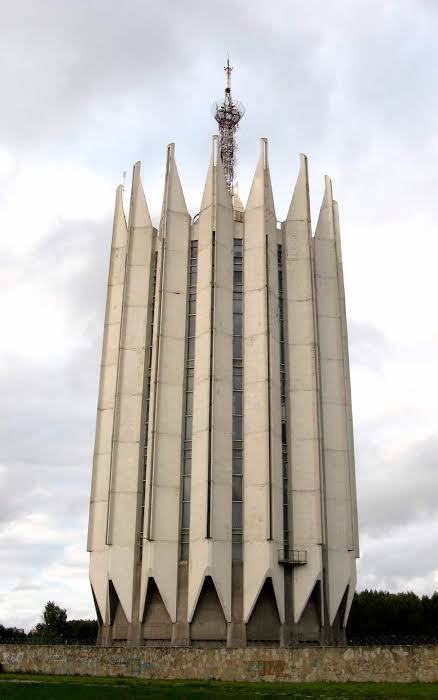
The Russian State Scientific Center for Robotics and Technical Cybernetics (CNII RTK) on Tikhoretsky Prospekt is arguably the most famous brutalist building in St. Petersburg. Its 77-meter tower—hollow, designed for testing spacecraft equipment—rises above a complex of severe geometric volumes, earning it the local nickname “Sauron’s Tower” . The building’s proximity to Sosnovka Park, with its dense forest, only heightens the sense of encountering something out of science fiction. For many visitors, this is the single image that defines Leningrad brutalism: futuristic, ominous, and utterly unapologetic.
Location: Tikhoretsky Prospekt, northern St. Petersburg.
Additional Sites Worth Seeking
-
Pribaltiyskaya Hotel (Vasilyevsky Island): A massive H-shaped hotel clad in anodized metal, part of the never-fully-realized “sea façade” of Leningrad .
-
Russian State Naval Archive (Prospekt Obukhovskoy Oborony): A towering rectangular box completed in 2006 after decades of delays—brutalism at its most utilitarian .
-
The “Glass” Houses (Prospekt Prosveshcheniya): Eight circular residential towers resembling concrete cups, pure in their functional geometry .
-
St. Petersburg College of Shipbuilding : Features two triple-gun turrets from the WWII cruiser Kirov as memorials, set against a severely brutalist façade .
Why Travelers Seek Out Brutalism in St. Petersburg
The appeal is multifaceted. For architecture enthusiasts, St. Petersburg tours offers something rare: a concentrated collection of late Soviet brutalism in a city that is otherwise defined by neoclassical and baroque splendor. The contrast is the point. Seeing a concrete monolith framed against the Winter Palace’s green-and-white façade, or discovering a stalactite hotel a five-minute walk from Nevsky Prospekt, produces a jolt of cognitive dissonance that is deeply satisfying.
There is also the photographic allure. Brutalist buildings photograph beautifully in the low, angled light of St. Petersburg’s winters, when the concrete takes on a cold, blue-grey luminosity. The “Tower of Sauron” against a pale sky, the chicken-leg houses reflected in the Smolenka, the Marine Station’s sail-like façade against the Gulf—these are images that circulate on social media and in architectural journals, drawing a steady stream of visitors who want to capture them in person.
Then there is the historical curiosity. For younger travelers, particularly those from outside the former Soviet Union, these buildings are artifacts of a vanished system—monuments to a society that believed in collective progress, state planning, and the aesthetic of the future. They are not merely buildings; they are documents. And for Russians themselves, particularly those who grew up in the late Soviet period, there is a complicated nostalgia at play: recognition, perhaps affection, mixed with the knowledge that these structures were built on promises that were not kept.
Finally, there is the sheer adventurousness of the hunt. Brutalist St. Petersburg is not served up on a platter. The buildings are scattered across residential districts, industrial zones, and windswept waterfronts. Finding them requires metro rides, long walks, and a willingness to venture beyond the tourist core. For travelers who have already seen the Hermitage and the Church of the Savior on Spilled Blood, this is a way to feel like an explorer in a city they thought they knew.
Why a Private Guided Tour Is the Best Way to See It
You can, of course, seek out these buildings on your own. Armed with a map and a list of addresses, a determined traveler can visit the major sites. But brutalism in St. Petersburg rewards—arguably requires—local expertise, and a private guided tour offers advantages that independent exploration cannot match.
First, there is the matter of context. A brutalist building without explanation is just a large concrete structure. With a knowledgeable guide, it becomes a story about postwar reconstruction, Khrushchev’s housing reforms, the translation of Banham’s New Brutalism into Russian, the rivalry between Leningrad and Moscow architects, the constraints of conservation zones, and the ideological battles over ornament and function . The difference between seeing and understanding is enormous, and a guide bridges that gap.
Book a Soviet history tour in St Petersburg
Second, navigation. Many of the best brutalist sites are in non-touristic districts—Vasilyevsky Island’s western edge, the northern residential sprawl around Tikhoretsky Prospekt, the industrial fringes near the Obvodny Canal. Public transport is efficient but not always intuitive for visitors, and the distances between sites are significant. A private tour with a vehicle solves this problem, allowing you to cover in a half-day what might take two days of independent wandering. Professional tour operators in St. Petersburg offer specialized modernist and brutalist itineraries that group sites by district, with expert guides who know the buildings intimately .
Third, access and timing. Some brutalist interiors—the Marine Station’s grand vestibule, the LETI corpus’s courtyard spaces—are not always open or easy to enter. A guide knows when buildings are accessible, which entrances to use, and how to frame the experience. They also know the best times of day for photography, when the light hits a particular façade or when a site is least crowded.
Fourth, the stories you cannot find in books. Local guides bring anecdotes, controversies, and personal memories. They can tell you about the debates over the Russ Hotel’s “stalactite” form, the nickname “Sauron’s Tower” and the childhood fascination it inspired, the unrealized plans for Vasilyevsky Island’s waterfront, and the ongoing threats of demolition or reconstruction that hang over several of these buildings . These narratives transform a tour from a lecture into a conversation.
Finally, a private tour is flexible. You can linger at the sites that interest you, skip those that do not, and adjust the itinerary to your pace and interests. Whether you are a photographer chasing the perfect angle, an architect studying structural details, or a curious traveler with a general interest in Soviet history, a private guide can tailor the experience accordingly. For a city as rich and layered as St. Petersburg, that flexibility is invaluable.
FAQ
What exactly is brutalism, and how is it different from Soviet modernism?
Brutalism is a subset of modernist architecture characterized by massive, monolithic forms, exposed raw materials (especially concrete and brick), and a lack of applied decoration. In the Soviet context, “Soviet modernism” is the broader category encompassing the architectural output from the mid-1950s to 1991, while brutalism refers specifically to the more sculptural, expressive, and materially honest strain that emerged in the 1970s and 1980s . Not all Soviet modernist buildings are brutalist, but many of the most distinctive ones are.
Are these buildings accessible to the public?
Many are. The Marine Station exterior is viewable at any time, though the interior is currently unused. The “houses on chicken legs” are private residences, so you can photograph them from the street but cannot enter. The LETI Fifth Corpus is an active educational institution; exterior viewing is straightforward, but interior access requires permission. The Avtobaza is a functioning facility. A guided tour helps navigate these access questions and ensures you do not inadvertently trespass or miss something you could have seen.
Is it safe to visit these areas?
Yes, the districts where brutalist buildings are located—Vasilyevsky Island, the northern residential areas around Tikhoretsky Prospekt, the neighborhoods near the Marine Station—are ordinary residential and institutional areas of St. Petersburg. They are not tourist zones, but they are not dangerous. Exercise the same common-sense precautions you would in any large city. A private tour eliminates any concerns about navigation or unfamiliar territory.
What is the best time of year to see brutalist architecture in St. Petersburg?
Late autumn and winter are arguably the best seasons for brutalism. The low, angled light and the frequent overcast skies create dramatic contrasts between concrete surfaces and shadows, and the absence of foliage reveals the full geometric severity of the buildings. Snow on raw concrete is particularly striking. Summer offers long daylight hours for photography but softer, flatter light.
How long does it take to see the major brutalist sites?
A focused half-day tour with a vehicle can cover the Vasilyevsky Island cluster (Marine Station, chicken-leg houses, Pribaltiyskaya Hotel) or the northern cluster (Robotics Institute, LETI, residential towers). To see all the major sites across the city, plan for a full day or two half-days. Independent travel using public transport will take considerably longer.
Can I visit these buildings independently without a guide?
Absolutely. Many travelers do. However, you will need to research each site’s location and access conditions, plan efficient routes, and accept that you may miss contextual information and stories that a guide would provide. For the most famous sites—the Robotics Institute, the Marine Station, the chicken-leg houses—independent visits are entirely feasible and rewarding.
Are any of these buildings at risk of demolition or alteration?
Yes. The Russ Hotel’s main façade has been discussed for reconstruction, and the building’s future is uncertain . The Marine Station has been unused for years, and its long-term fate is unclear. The Avtobaza’s status as a recognized monument of Soviet modernism offers some protection, but the broader category of late Soviet architecture is not universally valued, and preservation battles are ongoing. This is another reason to visit sooner rather than later—and to support the guides and organizations working to document and protect this heritage.
St. Petersburg will always be a city of palaces and canals, and those are worth every minute you spend on them. But the brutalist Leningrad is a reminder that cities are not static. They accumulate layers, contradictions, and uncomfortable beauties. The concrete giants on the outskirts are not interruptions of the St. Petersburg story; they are part of it. To seek them out is to understand the city more fully—and to see a side of it that most visitors never notice.