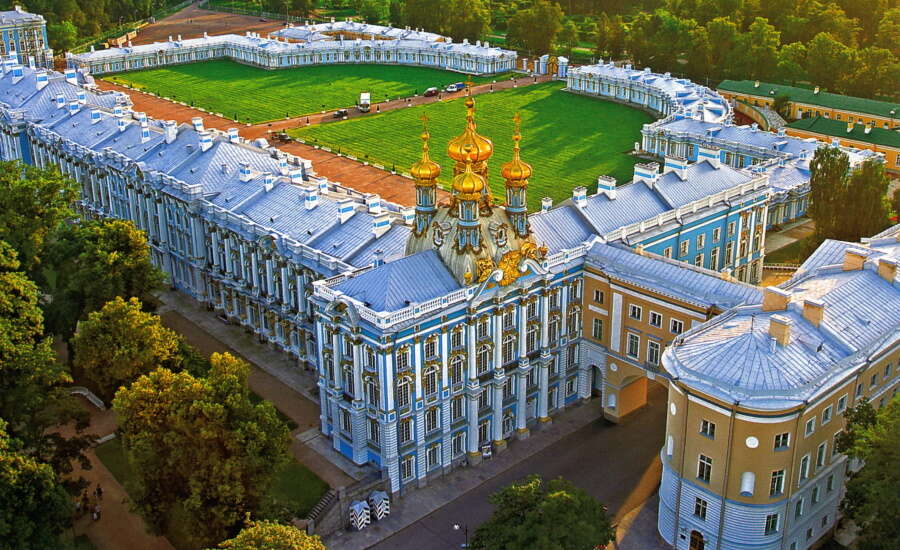
A private guided tour of Catherine Palace is not simply a faster way to see a famous building. It is a fundamentally different experience of one of Europe’s most extravagant royal residences, shaped by restricted access, specialized guides, and the ability to move through the Golden Enfilade without the pressure of a large group. Located in Tsarskoye Selo, roughly 25 kilometers south of St. Petersburg, the palace was designed by Bartolomeo Rastrelli to outshine Versailles, and its blue-and-gold façade stretches for more than 300 meters . A private tour turns that scale from overwhelming into intelligible, allowing you to read the palace as a sequence of political statements, personal retreats, and restoration triumphs.
The Logistics Before the Gold: Meeting Points and Access
Private tours of Catherine Palace typically begin with arrangements that bypass the ordinary visitor flow. Official individual excursions meet guests at the central Golden Gates, with parking available on the museum grounds, and proceed directly into the state rooms under the guidance of a dedicated museum guide . This is a meaningful detail: the palace is not simply opened to private groups at will, but through a formal program that limits numbers and requires advance booking. The official individual tour of the main palace lasts one hour and is priced at 37,500 rubles for a group of up to five, with an additional 7,500 rubles per extra guest, capped at fifteen people . Third-party operators often combine the palace with transport from St. Petersburg, skip-the-line admission, and an English-speaking guide, sometimes bundling a visit to nearby Pavlovsk Palace into a full day . The practical upshot is that a private tour buys not just commentary but choreography: you arrive, you enter, and you are moved through the palace according to a schedule that few independent visitors can replicate.

Through the Golden Enfilade: The State Rooms
The heart of any Catherine Palace tour is the Golden Enfilade, a continuous suite of state rooms that runs the length of the building and was designed for ceremonial display. In a private setting, the guide can slow down or speed up according to your interests, but certain rooms anchor the experience. The Great Hall, nearly 1,000 square meters in size, is draped in gold and lined with mirrors and enormous chandeliers, and it establishes the scale of Rastrelli’s ambition immediately . From there, the enfilade unfolds through a series of increasingly intimate spaces: the Cavalier’s Dining Room, the White State Dining Room, and the Picture Hall, each with its own logic of display and reception. The official private tour promises passage through the parade halls of the Golden Enfilade with individual guided service, and the option to visit the Guest Rooms before or after the main route . What distinguishes the private experience here is not access to hidden rooms—the state rooms are the same ones everyone sees—but the ability to stand in them without being herded, to ask about the amber panels’ loss, the use of mirrors to multiply candlelight, or the way Rastrelli’s blue walls signal a shift from cold formality to something warmer.
The Amber Room: Expectation and Encounter
No discussion of Catherine Palace can avoid the Amber Room, and a private tour does not change what you see so much as how you see it. The room’s original amber panels were a Prussian gift to Peter the Great, installed in the palace, and then looted and lost during World War II; what visitors see today is a reconstruction completed over two decades using old photographs and traditional techniques . The reconstructed room contains six tons of amber, gold, and mirrors, and it glows with a warmth that photographs only partially capture . In a private tour, the guide can prepare you for the room’s strange emotional register: it is simultaneously a triumph of craftsmanship, a monument to loss, and a deliberate act of cultural memory. Because private groups move on a timed schedule, the visit to the Amber Room is typically brief, but the guide’s commentary can make the briefness feel deliberate rather than rushed. Independent visitors often describe the room as the climax of the tour, and private guides know this, often saving context and anecdote for the approach so that the room itself can be experienced with fewer words.
Book a Catherine Palace day trip from St Petersburg
Beyond the Main Route: The Zubov Wing and Private Rooms
One of the clearest advantages of arranging a private tour through official channels is the possibility of adding or substituting the Zubov Wing, a separate tour focused on Catherine II’s private rooms. This route, sometimes called “Catherine II. Personal Space,” includes the Domed Hall, Chinese Hall, Silver Study, Blue Study, Bedchamber, Mirror Study, Raphael Room, Dressing Room, Lyons Hall, and Arabesque Hall . These are not the parade rooms of the Golden Enfilade but the interiors where the empress actually lived and worked, and they offer a different portrait of Catherine: as a collector, a reader, and a woman who curated her own privacy within a palace built for spectacle. The Zubov Wing tour is capped at ten visitors and is open Friday through Wednesday, with timed admission and no audio guides currently available . A private guide can connect the two experiences—the public enfilade and the private wing—into a single argument about how Russian monarchy staged power and retreat. For travelers with a serious interest in Catherine’s reign rather than a checklist of highlights, this combination is the strongest case for going private.

The Guide as Interpreter: Expertise and Language
The quality of a private tour depends disproportionately on the guide, and this is especially true at Catherine Palace, where the visual density of the interiors can overwhelm without interpretation. Official private excursions provide individual guided service in the palace, though the language offerings may vary and should be confirmed at booking . Third-party operators advertise professional English-speaking guides, separate drivers, and radio headsets for larger groups . The difference matters because Catherine Palace is a site where surface beauty can obscure historical complexity: the amber that glows on the walls is a reconstruction, the gold that covers the façade required an extraordinary quantity of precious metal, and the palace itself was burned and rebuilt. A good private guide does not just identify rooms; they explain the difference between what survived, what was restored, and what was invented. For visitors without Russian, a private tour is often the only way to access that layer of meaning, since independent visitors may find limited English signage and crowded conditions that make reading difficult.
Gardens, Time, and the Shape of the Day
A private tour of the palace usually includes or can include time in Catherine Park, the surrounding landscape of formal gardens, ponds, and pavilions that was designed as an extension of the palace’s theatricality. The park is not included in palace admission and must be paid separately, a detail that private tour operators typically handle in advance . Because private tours are scheduled rather than spontaneous, the day has a shape: transport from St. Petersburg, arrival at the gates, a focused hour or more inside, and then time to walk the grounds without the anxiety of a return bus deadline. Some operators combine Catherine Palace with Pavlovsk Palace for a full-day private excursion, including skip-the-line access and a separate driver . Others focus on the palace alone, allowing a slower pace. The official private program’s one-hour duration is compact, but the surrounding logistics—parking, entry, the walk from the gates—mean that even a short private visit occupies a half-day when travel from the city is included.
Practical Expectations: Closures, Timing, and Temperament
Catherine Palace operates on a schedule that rewards planning and punishes assumptions. The palace is closed on Tuesdays, and from November through mid-April it also closes on the last Monday of each month; the Zubov Wing closes on Thursdays and the last Wednesday of each month from November through March . Private tours must be booked in advance, and official individual excursions are available only during working hours for a limited number of visitors . The Amber Room is extremely popular, and even private groups are subject to timed admission; weekday mornings are generally less crowded than weekends . Visitors should also expect a moderate amount of walking, uneven surfaces in some areas, and the general temperament of a historic palace: warm in summer, cold in winter, and never quite as comfortable as a modern museum. The private tour does not remove these realities, but it does buffer them with organization, a known schedule, and a guide who knows where the group is going next.
Conclusion: What the Private Tour Actually Delivers
The private guided tour of Catherine Palace delivers three things that independent visits cannot reliably provide: controlled access, interpretive depth, and the ability to connect the palace’s spectacle to its history. The Golden Enfilade and the Amber Room are the same for everyone, but a private guide turns them from beautiful rooms into evidence of ambition, loss, and reconstruction. The Zubov Wing, when available, adds the intimate counterpoint to the public grandeur. And the logistics—meeting at the Golden Gates, timed entry, a known duration—remove the friction that can make a crowded palace visit exhausting. For travelers who want to understand why Catherine Palace matters, rather than simply photograph it, the private tour is less a luxury than a form of translation. It does not make the gold any less bright, but it explains what the brightness was for. Enjoy your tours in St Petersburg.
Book your private tour to Catherine palace today