Palaces, Canals, and Hidden Courtyards: What to Really Expect on a Guided Walking Tour of St. Petersburg
A guided walking tour in St. Petersburg is not simply a stroll past grand facades. It is an immersion into a city deliberately designed to astonish, a place where every canal, courtyard, and gilded spire carries the weight of three centuries of imperial ambition, revolution, and survival. Whether you join a small-group overview, a private history-focused excursion, or a themed wander through literary haunts, the experience follows a distinctive rhythm. You will cover a compact but dense historic core, typically over three to four hours, and you will quickly discover that in St. Petersburg, the most memorable moments often lie not in the headline sights themselves, but in the stories that connect them.

A Note Before You Go: The Practical Realities
Before describing the pleasures of the route, it is essential to address the context in which any tour currently takes place. Several Western governments have issued severe travel advisories for Russia, citing the ongoing conflict with Ukraine, the potential for drone attacks affecting western Russia including the area around St. Petersburg, restrictions on financial services, and the risk of arbitrary detention or arrest of foreigners . Mobile connectivity for foreign SIM cards can be unreliable or delayed upon arrival, and access to some international banking and social media services is restricted . These are not incidental details. They mean that a private tour in St. Petersburg today occurs within a heightened security environment, and travelers should consult their own foreign ministry’s current guidance, ensure they carry proper documentation at all times, and maintain a low profile regarding political commentary in public spaces . The city’s beauty remains, but the backdrop is more complicated than the postcard image suggests you should also think about the best time to visit St Petersburg.
The Starting Point: Palace Square and the Imperial Stage
Most comprehensive walking tours begin where the city’s imperial identity is most concentrated: Palace Square. Standing here, your guide will likely begin not with the Winter Palace itself, but with the square as a stage for power. You will hear about Elizabeth Petrovna’s decision to commission a new palace rather than renovate the old one, and the legends that cling to the site—including the curious tale of imperial cows once grazing on the square’s grounds . The Alexander Column, a single piece of granite nearly fifty meters tall, anchors the space, and your guide may share the story of the architect Auguste de Montferrand, who reportedly walked around his creation every day until his death, as if unable to leave it behind .
From Palace Square, the route typically flows toward the embankments. The Neva River opens up before you, with the Peter and Paul Fortress visible across the water, its slender spire marking the city’s original founding point in 1703 . This is a moment for orientation: your guide will point out the Admiralty, the Hermitage complex, and the sweep of the Palace Embankment, knitting the geography together so that the rest of the walk makes spatial sense.
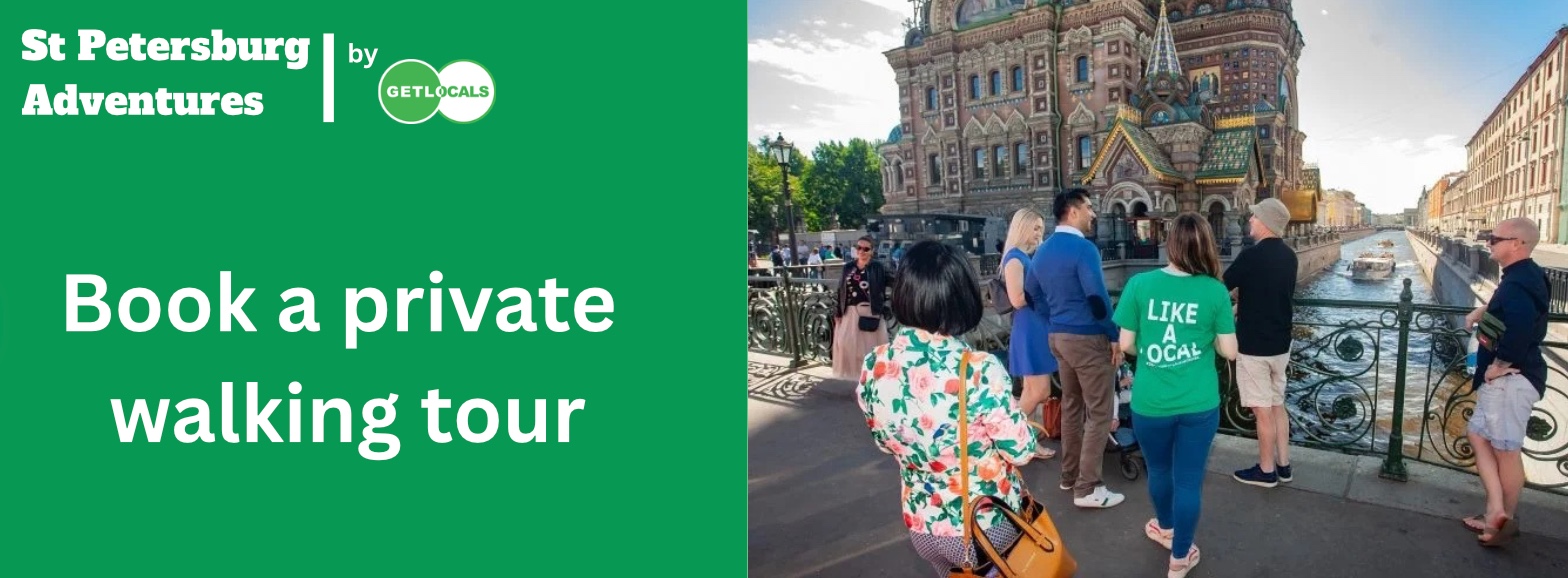
Book a private walking tour St Petersburg
The Cathedral Circuit: St. Isaac’s, Kazan, and the Church on Spilled Blood
A standard three-hour overview will bring you to at least two, often three, of the city’s major cathedrals, though interior visits vary by tour. St. Isaac’s Cathedral, with its massive gold dome and colonnades of Finnish granite, dominates St. Isaac’s Square. Many group tours view it from the outside and offer optional interior entry; those who go in encounter mosaics, malachite columns, and a scale of opulence that can feel almost disorienting . The cathedral’s history as a museum of atheism during the Soviet period is a story your guide will likely tell, illustrating how the city’s monuments have been repurposed across regimes.
The Kazan Cathedral, by contrast, is often entered. Its colonnade, inspired by St. Peter’s in Rome, curves toward Nevsky Prospect, and inside, the atmosphere is quieter, still functioning as an active place of worship. Guides frequently point out its role as a monument to the 1812 victory over Napoleon . Then comes the Church of the Savior on Spilled Blood, perhaps the most visually arresting structure on the route. Built on the exact spot where Alexander II was assassinated in 1881, its onion domes and mosaic-covered interior are designed to be seen both from outside and within. The exterior alone, with its intricate brickwork and enameled cupolas, is usually enough to make a group fall silent for a moment .

Nevsky Prospect and the Art of Looking Up
No walking tour of St. Petersburg omits Nevsky Prospect, but the quality of a guided walk lies in what you are taught to notice. A good guide will not simply march you down the boulevard; they will stop you in front of the Singer Building and explain the American sewing machine company’s unlikely imprint on the imperial capital, or point out the Atlantes of the Hermitage, or draw your attention to the smallest details—a mascarón here, a hidden monogram there . One tour even provides binoculars so that participants can examine the facades’ sculptural details, from American eagles to Masonic symbols, turning a simple avenue into a scavenger hunt of imperial-era visual codes .
You will also learn about the literary ghosts that populate the street. Pushkin’s favorite confectioner, the spots where Gogol and Dostoevsky set their scenes, the building where the first Russian cinema opened—these anecdotes transform Nevsky from a shopping street into a layered text . Expect to walk roughly two to three kilometers over the course of a typical tour, with pauses that make the distance feel less like exertion and more like a series of small discoveries .
Beyond the Obvious: Courtyards, Legends, and Themed Walks
The range of guided walking tours in St. Petersburg extends well beyond the standard overview. If you choose a themed walk, the city reveals different faces. A literary tour might trace Pushkin’s addresses or Dostoevsky’s fictional geography. A “mystical” tour explores the city’s reputation for ghost stories, Masonic symbols, and the so-called “bad apartments” of urban legend . An immersive family walk might use headphones and interactive storytelling, blending history with games and even a small gift at the end . There are tours focused on the city’s courtyards and communal apartments, offering a glimpse of everyday life behind the monumental facades .
This variety matters because St. Petersburg can overwhelm with grandeur. A guide who specializes in a niche—be it architecture, literature, or the city’s darker folklore—can make the scale human. You might find yourself in a quiet courtyard off Nevsky, learning about the people who lived there rather than the emperors who commissioned the buildings, or standing before a seemingly ordinary wall where a poet once wrote a line that outlasted the regime that silenced him.
The Rhythm of the Walk: What a Typical Three Hours Feels Like
A standard small-group walking tour in St Petersburg, limited often to around twelve people, generally begins at a central meeting point such as Palace Square or near Nevsky Prospect and lasts approximately three hours . The pace is moderate, with frequent stops. Your guide will manage the group’s movement through crowded areas, and there is usually a mid-tour pause—sometimes at a café for blini or borscht, sometimes simply a few minutes to sit on a bench in the Summer Garden or the Field of Mars . The Summer Garden, one of the city’s oldest green spaces and a favorite of Peter the Great, offers a particularly welcome respite from the stone and traffic, though it is closed on Tuesdays .
What you will not do on most standard tours is enter the Hermitage or spend extended time inside museums. These walks are orientation and storytelling experiences, designed to give you the lay of the land and the arc of the city’s history. Interior visits to St. Isaac’s or the Church on Spilled Blood are sometimes optional add-ons, but the core of the tour is the street itself—the facades, the embankments, the squares, and the stories that connect them .

The Guide’s Role: More Than a Lecturer
The best guides in St. Petersburg function as translators not of language, but of context. They will explain why a building looks the way it does, who paid for it, what it became after the revolution, and what it means to the people who walk past it today. They will point out the shift from the baroque exuberance of Rastrelli to the austere neoclassicism of Rossi and Montferrand, and they will connect those aesthetic choices to the political moods of the emperors who commissioned them . They will also, if they are good, tell you where to find the best coffee after the tour ends.
Because the city’s history is so dense, a guide’s editing is as important as their knowledge. They choose which stories to tell and which to leave out. A tour focused on the Romanovs will dwell on palace intrigues and assassination plots; a tour focused on the siege of Leningrad will speak in quieter tones about survival and memory. The best tours acknowledge the full arc—the glory, the cruelty, the suffering, and the resilience—without reducing the city to a single narrative.
Final Impressions: What You Carry Away
By the end of a guided walking tour in St. Petersburg, you will likely feel a strange contradiction. The city is visually overwhelming, yet the walk itself is intimate. You have covered only a few kilometers, yet you have moved through three centuries. You have stood in squares where emperors rode and revolutions began, and you have peered into courtyards where ordinary people hung their laundry. The guide’s voice has woven these scales together, making the monumental and the mundane feel like parts of the same story.
You will leave with sore feet and a mental map that no guidebook can provide: the shortcut through the Summer Garden, the café near St. Isaac’s where you warmed up, the exact spot on Nevsky where the guide stopped and said, “Look up.” And you will understand, perhaps more clearly than before, that St. Petersburg is a city that demands to be walked—not because the distances are short, but because its secrets are hidden in plain sight, waiting for someone to point them out.